• Kenaz, torch, branch alight— 
    Fire of creation, will to generate
    And regenerate through sacrifice—
    Forge passage from this heart new
    Lifeblood glinting on Ginnungagap
    For another world. Shine on our red
    Scrabbling in the concrete ruins of empire;
    Rouse this army of limbs from bed
    As the castle falls, having finally slighted
    Itself, and show how it looks like dawn
    Metered by the exact science
    Of hindsight.
    Let Odin hang 9,000 years this time.
    Let jötnar and troll-women bathe in
    Destiny’s Well
    This time.
    Allfather, have you learned enough
    This time?

    dedicated to those who continue to burn it down

    Additional context:

    In Norse mythology, Yggdrasil is the World Tree that holds the Nine Realms.

    In the beginning, the primordial void Ginnungagap births Muspell, the fire realm, and Niflheim, the ice realm. From the melting rime of their proximity, Ymir the great sexless jötunn (sometimes translated as ‘giant’) was born, and from Ymir all jötnar are descended, including Odin.

    Odin, the All-Father, slaughters Ymir to fashion the rest of the Realms and its peoples from their body. He has no love for other jötnar, often tricking, stealing from, and killing them, and distinguishing himself apart from them despite direct lineage. Odin famously sacrifices himself to himself by hanging nine days upon Yggdrasil with no food or water, and often sits at a Well down at its roots discussing the future with a severed head. Odin gouges his own eye out to learn rune magic. He is always hungry for more knowledge of the future, yet never learns to quell the violence apparently essential to his being.

    Kenaz (ᚲ), the sixth rune of the Elder Futhark (ᚠᚢᚦᚨᚱᚲ), has the phonetic sound of K and is derived from the Old English cén, meaning torch. Known in Old Norse as kaun (“ulcer”), there is an additional meaning for ᚲ of the internal fever-fire.

    Kenaz is a rune of illumination, creative inspiration, and transformation, and is associated with Loki — the trickster shapeshifter who may have been birthed by Muspell‘s native fire (“logi“) itself or born of lightning striking leaves. Like fire for humans, Loki both poses great danger to the gods and gives them fantastic gifts.

    It is tension between Odin and Loki that ultimately brings about Ragnarök, i.e., the Norse endtimes. The gods and jötnar battle, Yggdrasil burns and sinks into the sea.

    There are a lot of White supremacists out there who love Norse mythology too, and one way to identify them is if they call themselves Odinists. If Loki is the god of queer people who see themselves reflected in an ancient genderfluid anarchist, Odin has become the god of white men who don’t like Christianity but still yearn for an all-knowing patriarch.

    In my reading of the mythos, Odin attempts to kill off the jötunn part of himself through self-sacrifice and names himself something different, Æsir, now of the race of gods.

    I wanted to dunk on Odin a little in this poem, yes, but mainly I wanted to express the power and clarity I feel when we talk about burning down this whole violent system in America.

    There is no reforming a nation that shoots and kidnaps people on the street. There is no reforming a nation that puts people in cages. There is no reforming a nation that bombs other sovereign nations for oil and gas. There is no reforming a nation built by enslaved African peoples. There is no reforming a nation that began with a 96% genocide of its Native population.

    There is only abolition and abolition again.

    Not to put too fine a point on it, Yggdrasil will always burn and sink into the sea because it was formed from the murder of a queer Indigenous being and run by a dangerous gang of Æsir-supremacists.

    Loki will always emerge — elemental as the fire from Muspell that thawed Ymir — to bring the whole thing down.

    And like the new Tree that rises out of the sea again, we too will rebuild a better world.

    She sees rising up
    a second time
    the earth from the ocean,
    ever-green;
    the cataracts tumble,
    an eagle flies above,
    hunting fish
    along the fell.

    - from Völuspá
    Cards from the Nordic Myths Tarot deck by Kristín Ragna Gunnarsdóttir. Center art given to me by an excellent eight-year-old after I told her the story of Loki shapeshifting into a bridal handmaiden to retrieve Mjölnir.

  • Last week I had the opportunity to attend a bilingual school holiday program on the Isle of Skye where the local primary school is split into English-medium and Gaelic-medium modes of education.

    Starting in P1 (age 4-5), students on Skye have the choice to enroll in immersive Scottish Gaelic instruction that tapers off to include English-language classes by the middle of primary school. The goal is fluency in both Gaelic and English by the start of secondary (around age 12). Many families do not choose this option.

    Descended from Old Irish and a close relative to Modern Irish Gaelic, Scottish Gaelic has not yet enjoyed the same level of revitalization as Irish. There is an attitude I have picked up on in my travels that this “Definitely Endangered” (UNESCO) Indigenous language of Scotland is useless/for old people and rural bumpkins/only added to street signs for quaint tourist appeal.

    Despite this, the number of Scottish Gaelic speakers has risen slightly over the last decade. According to the 2022 census of Scotland, 2.5% of people reported having some level of skill in Gaelic compared to 2011’s 1.1%. For comparison: Ireland’s 2022 census reported nearly 40% of its population has some skill in Irish Gaelic, and about 18% of the population of Wales are native Welsh (from the other branch of Celtic languages) speakers.

    As I sat on a plastic chair listening to a group of Gaelic-medium 8-12 year olds singing carols in the language of Skye, I felt the old wooden beams of the Dunvegan Community Hall humming along with them. Having starry eyes for all things Indigenous revitalization and tracing half of my ancestry to Scotland, I felt that I would give so much to have this foundational bilingualism in Gaelic.

    I thought of a poem I wrote this year called "No" after confirming that I would not be able to legally stay in the UK:

    "I who know nothing
    Feel no magic in rowan
    Call herbs by their Latin
    Pay rent to the chieftain

    I who from nowhere
    Tread soft in your pasture
    Long-forgotten daughter
    Who asks to stay longer"

    And I thought of this section of Louis MacNeice’s 88-page poem “Autumn Journal” where he waxes pure angst about his birthplace, the North of Ireland, after studying and teaching in England for many years:

    "Let the school-children fumble their sums 
    In a half-dead language;
    [...]
    Let the games be played in Gaelic.
    [...]
    Why should I want to go back
    To you, Ireland, my Ireland?
    [...]
    [S]he gives her children neither sense nor money
    Who slouch around the world with a gesture and a
    brogue
    And a faggot of useless memories."

    The whole poem is very much worth a read and contextualizes this attitude from MacNeice, writing in 1938, who I believe would be delighted to see the boom of Irish Indigenous cultural resurgence happening today in 2025. I would love to sit down with him and watch Belfast (2021) and Kneecap (2024).

    Longing for pre-Christian, nature-based religions and endangered tongues I’ve never known — my own ancestral culture — is something I am trying to be more comfortable speaking about. Some British people will actively deride Americans for seeking out this connection, but I see this now as a colonial attitude that reinforces the category of Whiteness, i.e., “Stop trying to find an identity outside of White supremacy and capitalism!”

    I believe it is a healthy desire for European-Americans to want to connect to their own long-forgotten traditions, and if done respectfully can actually create more room for the revitalization of Native American cultures and languages in Turtle Island and other expressions of decolonization.

    My hope is that Scotland will continue to shrug off the shackles of the United Kingdom and pursue greater independence in all areas, including the promotion of Scottish Gaelic — recently officially recognized alongside Scots under the Scottish Languages Act 2025 (SLA 2025).

    Shoutout to the young people of Skye who filled my eyes with tears and heart with hope, and to everyone bumbling along awkwardly in their reconnection with a pre-colonial past toward a post-colonial future.

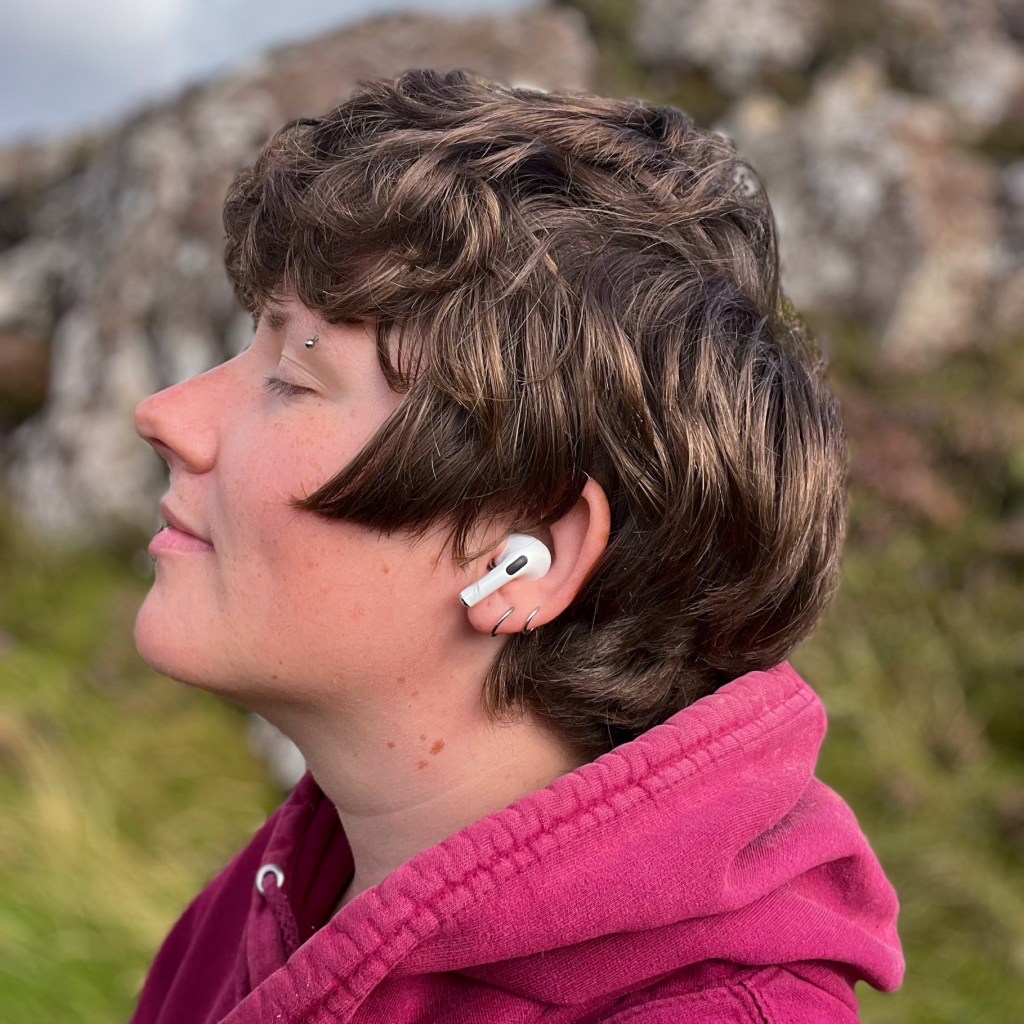
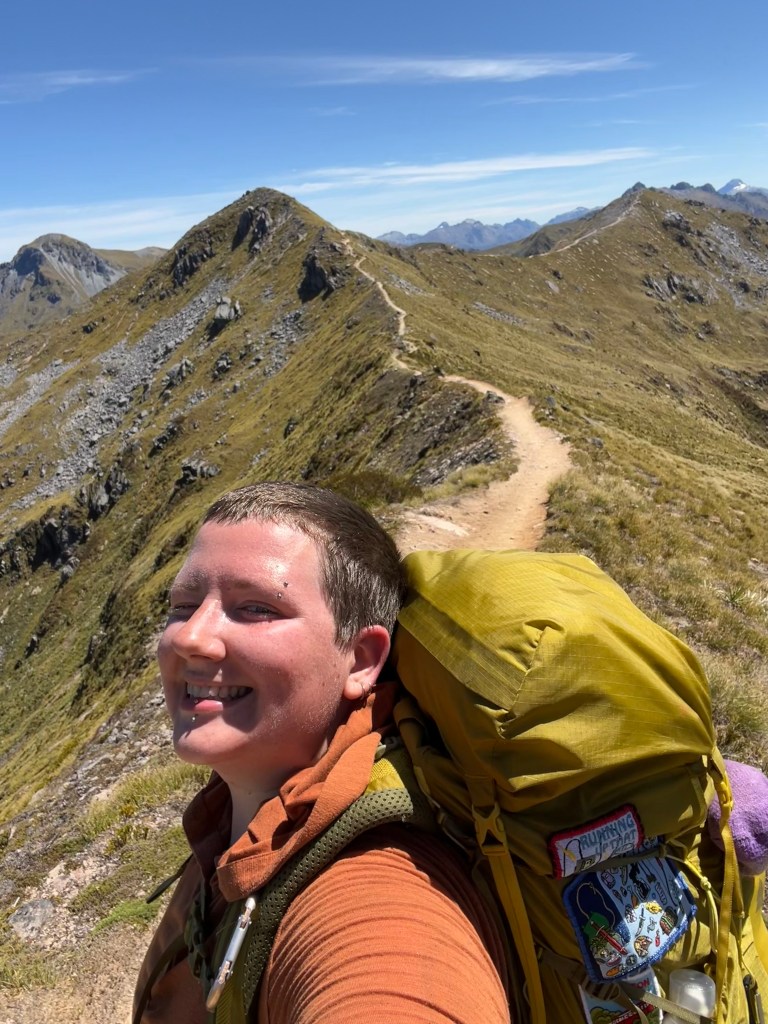
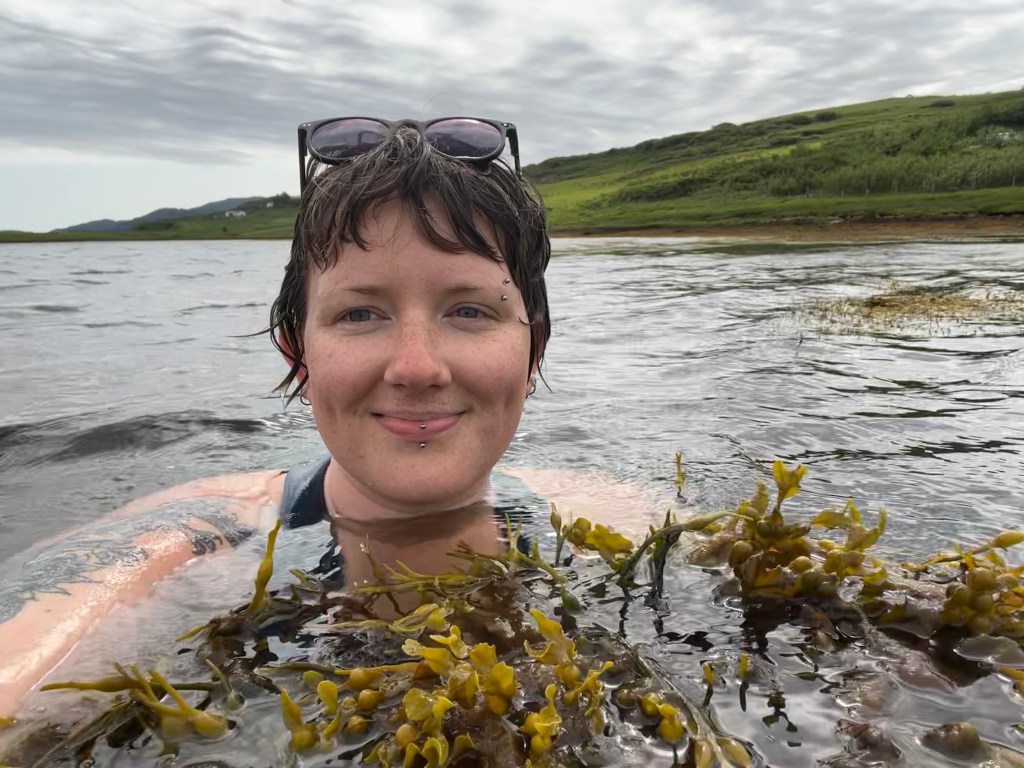
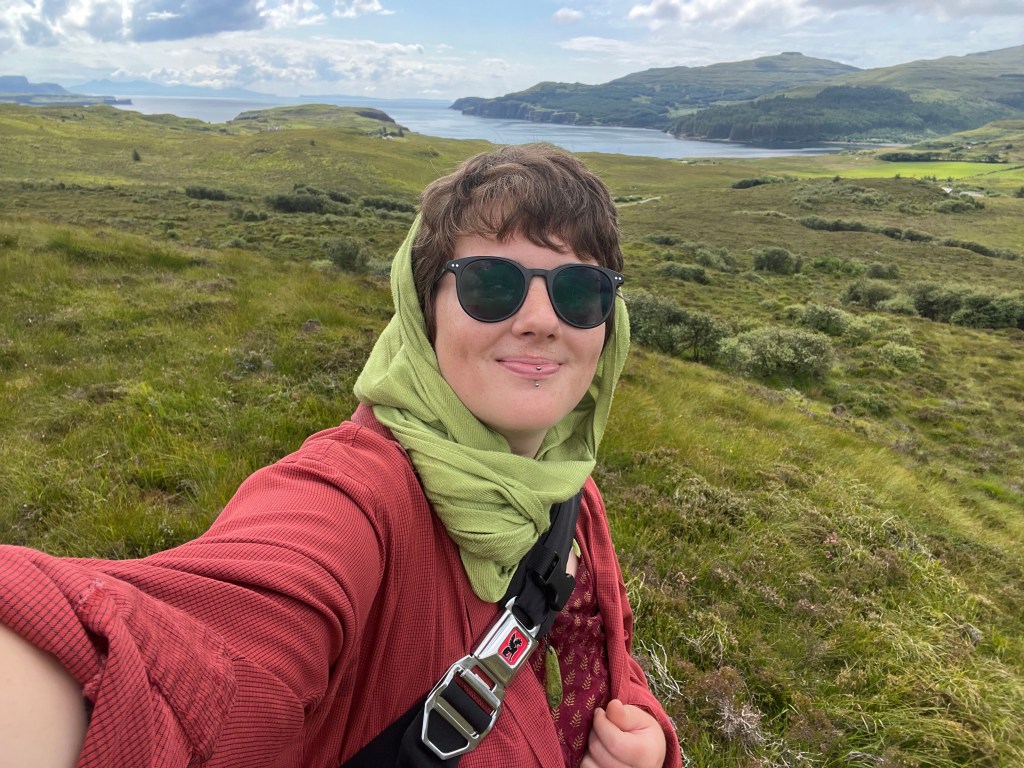
    Ruth taking a selfie on Skye in 2025. The background is yellowgreen moorland and the ocean.

  • Skirt hitched and gathered, the Old Woman treads the North Atlantic like a wading pool.

    Yes, Her calves are all gooseflesh.

    Yes, the wind is tangling grey hairs and tightening the itchy scarf round Her neck.

    And yes, since you asked, the basket of peat and stones She carries is wearing heavy on ancient bones and She would quite like to put it down now.

    So the Cailleach allows Her burden to drop, spilling great sods and boulders into the sea.

    *

    Hebrides and Highlands She fashioned this way, and if She shaped up the edges of the Western Isles with Her bare toes, pushed a few out of the way to leave a walking firth, that’s nae our business.

    Some say the Cailleach had a husband or two over in Éirinn, and children to show for it. That may be.

    Some say She used to wrestle with the Stoor Worm, long before he got all his teeth knocked out by a little brat looking for a magic sword. I do not know if that part is true, but I have heard how She filled several lochs with Her weeping when the great Worm left his liver in the North Sea and curled up to die under Ísland.

    Some say the Celts brought Her over in story and song when they paddled from Europe only a few thousand years ago, but that is the tallest tale of them all.

    No, the Cailleach was here amongst the early humans. Watched some of them traipse over Doggerland, saw the ocean drown that liminal realm and cut them off from the continent.

    And the Old Woman liked those little people who erected standing stone circles for Her, would even come out on Midwinter to feel the warmth of their fires.

    What interested Her too were the sheep they brought across the channel, for Her loom had only known the hair of Britain’s primitive goat.

    Yes, wool She could abide.

    **

    Hebridean Goddess, Winter Queen, Divine Crone, Ancestral Creator of landforms and waterways throughout Scotland and Ireland: I quite like this Old Woman who sits on Highland mountains and teaches nymphs to guard their streams — though She doesn’t need my approval or praise.

    Yes, I like this embodied Crone with Her feet in the ocean.

    The Cailleach is the perfect answer to an immaterial Sky Father such as the one described by Anne Sexton in her poem, “The Earth”:

    God loafs around heaven,
    without a shape
    but He would like to smoke His cigar
    or bite His fingernails
    and so forth.

    God owns heaven
    but He craves the earth,
    […]
    He who has no body.

    […]

    He does not envy the soul so much.
    He is all soul
    but He would like to house it in a body
    and come down
    and give it a bath
    now and then.

    (from The Awful Rowing Toward God, 1975)

    Unlike Sexton’s God who “loafs around heaven / without a shape” and longs to have “a body / and come down / and give it a bath / now and then,” the Cailleach has a shape and a body. She even has a plaid dress that She washes in the Minch.

    ***

    After spending many months on the Misty Isle, one of the Cailleach’s created lands where two hills of identical height (2,402 ft) bear the name “Beinn na Caillich” (‘mountain of the old woman’), I see and feel the Hebridean Creatrix this November. I relate to Her lonesome stature, too.

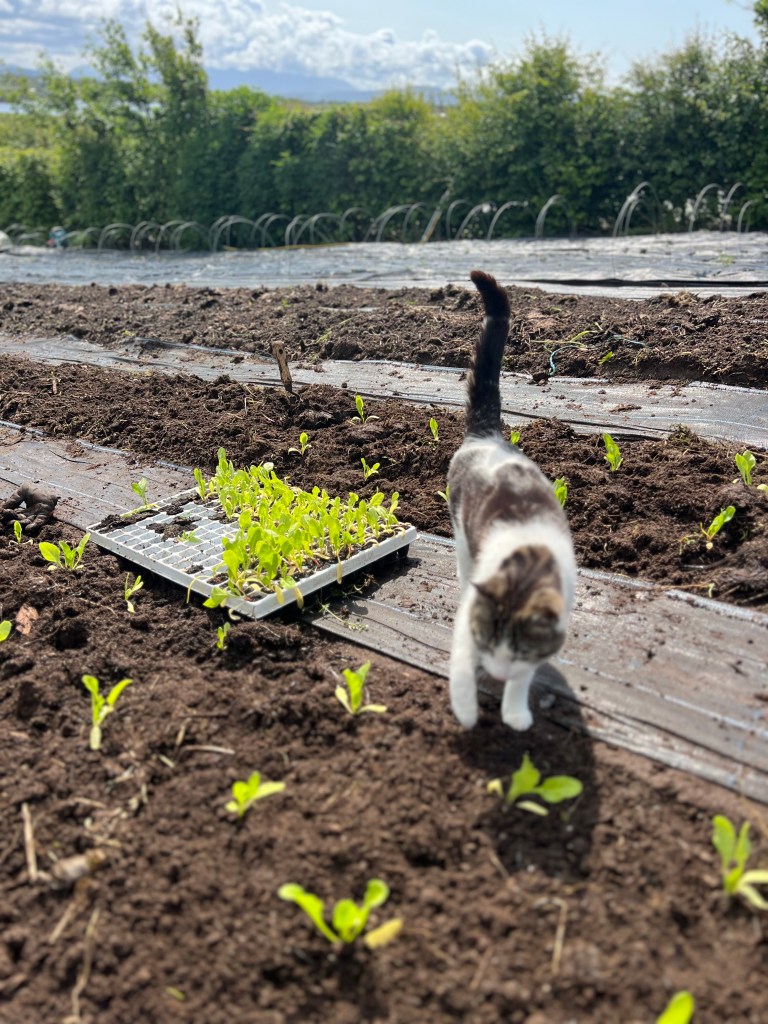
    Watching the croft for my Skye friends while they go away, I pretend this is my land: milk the goats, count sheep, collect eggs, pet the working mousers, dig around in the garden, drink cups of tea, make sure nothing blows away in the divine Crone’s winter gales, then retire for long nights of reading, drawing, and writing.

    It is this balance of engaging my creative practice and working outside in solitude that allows me to feel content, healthy, embodied, and real — and it is the Old Woman who reminds me that I too am a fundamentally autonomous creatrix, with a body that must return to quiet teachings on hills and run ever back to the sea like one of the Her swift mountain streams.

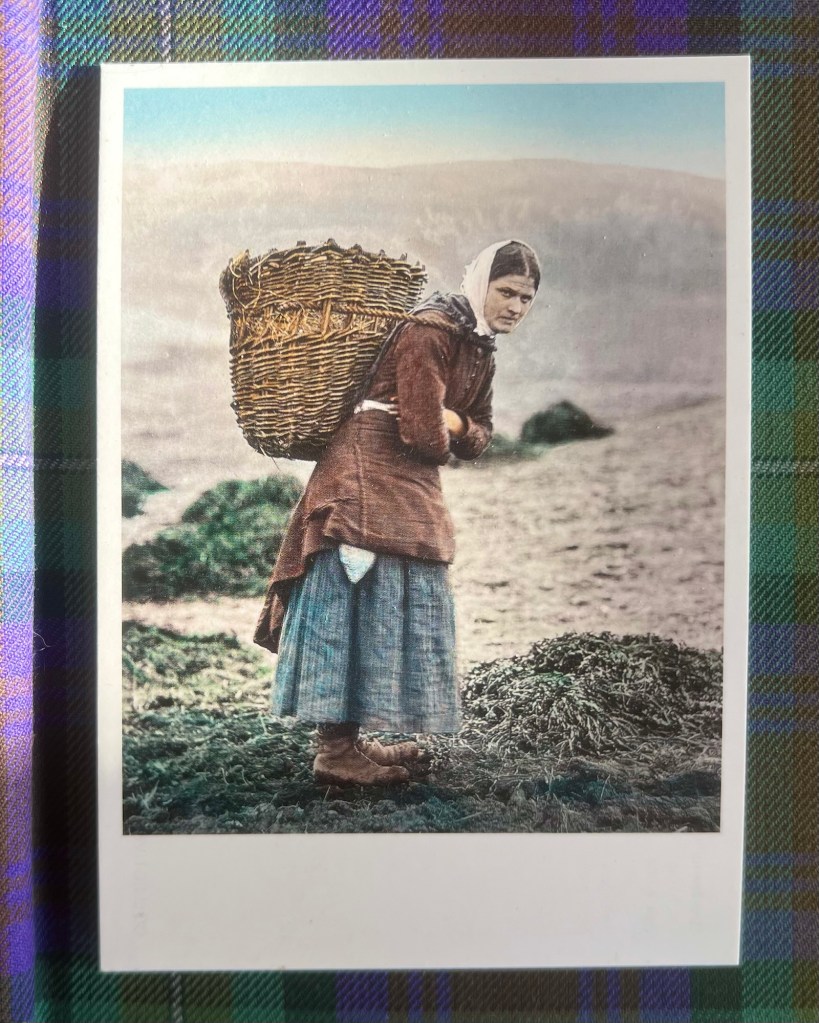
    Hebridean woman collecting seaweed, 1880s

  • This November, I wanted to read at least 10 new-to-me books by Native authors.

    Even while flat broke working a farm apprenticeship in a very rural area, I was able to hit that goal with relish thanks to Libby and Multnomah County Library’s initiative to provide unlimited digital access to their 300+ book NAHM collection! Shoutout to librarians. And to the Internet for being okay sometimes.

    In the end, five books resonated with me as perfect, five-star reads.

    NONFICTION

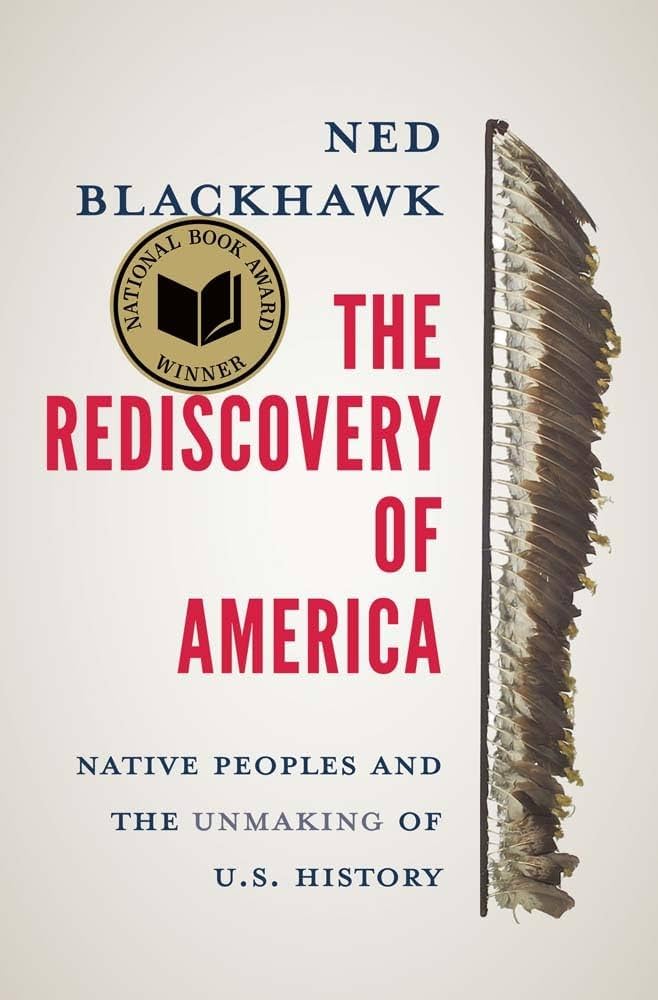
    1. The Rediscovery of America: Native Peoples and the Unmaking of U.S. History (2023) by Ned Blackhawk (Te-Moak Western Shoshone)

    This is my pick for an American history text, period.

    Ned Blackhawk’s analyses are sharp and incontrovertible. He will describe a familiar, foundational American moment and then follow it immediately with, “The Indigenous perspective, however, differs…,” explaining it so plainly you will be left wondering how our textbooks have gotten away with saying anything else for so long.

    I found it particularly illuminating when he discussed the erasure of Native feminisms through both the construction of white male democracy and the imposition of monogamous marital practices, all of which resulted in the consolidation of land into settler hands.

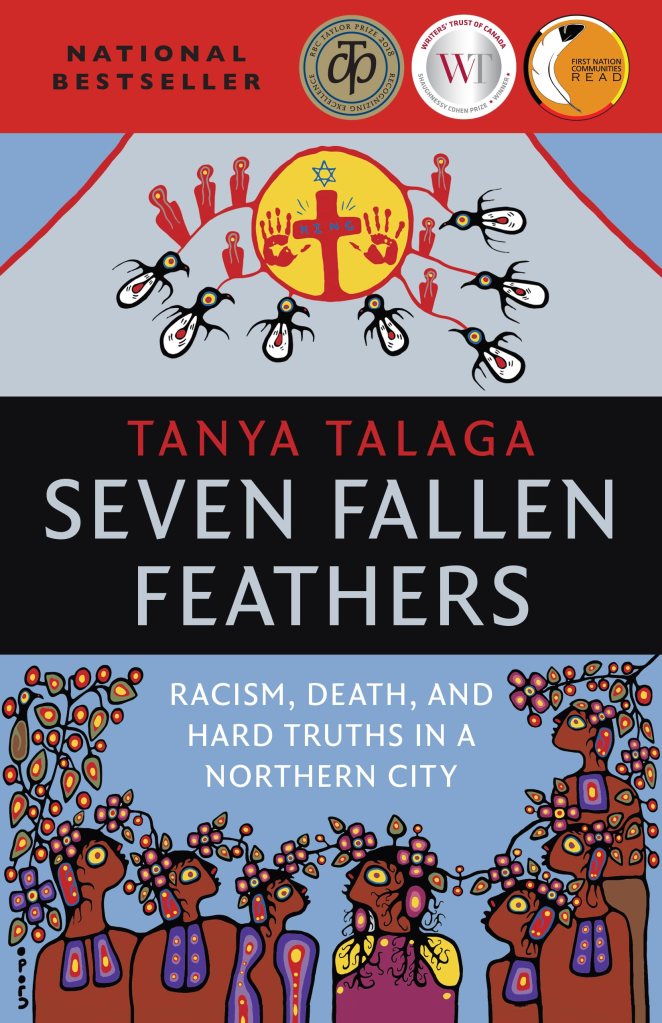
    2. Seven Fallen Feathers: Racism, Death, and Hard Truths in a Northern City (2017) by Tanya Talaga (Anishinaabe, Fort William First Nation)

    Seven Indigenous students attending the same school in Thunder Bay, Ontario died between 2000-2011.

    In a faultless, moving triumph of investigative journalism, Tanya Talaga situates us thoroughly in the culture and history of Thunder Bay, examining every angle of these mysterious deaths.

    One almost expects a monster to finally be revealed coming out of the woods and dragging students into the river, but as the narrative unfolds through testimony of families and elders, we understand that the monster is nothing less than settler-colonialism itself, and that even a well-intentioned successor to the violent residential school system bears many similar outcomes for Ontario’s Indigenous youth.

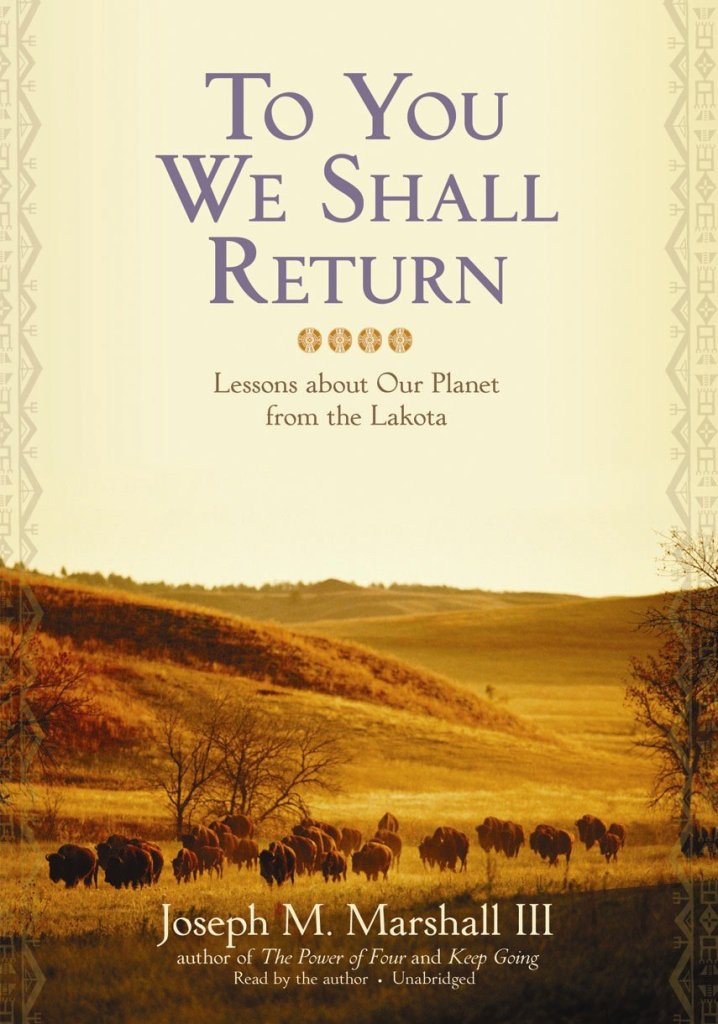
    3. To You We Shall Return: Lessons About Our Planet from the Lakota (2010) by Joseph M. Marshall III (Sicangu Lakota)

    This is a gentle work, concise and humble in tone, that stimulates deep thinking about our relationship to land.

    Joseph M. Marshall III describes growing up with his grandparents on the Rosebud Sioux reservation, showing us both the tenacity and endurance of Lakota peoples as well as the violent loss of traditional lifeways.

    Rest in peace to the author who died at 80 this past April.

    Grandmother, you who listen and hear all, you from whom all good things come,
    It is your embrace we feel when we return to you.”

    FICTION

    This month, I fell in love with the creative writing of Leanne Betasamosake Simpson (Michi Saagiig Nishnaabe, Alderville First Nation). Drawing from two decades of experience teaching in North American universities as a land-based Nishnaabe intellectual and musician, her work is literary, layered, funny, and weird.

    Simpson is the first fiction author I have read all year to go on my “will always read their new work” list.

    Pick up anything you find by her–then tell me about it!

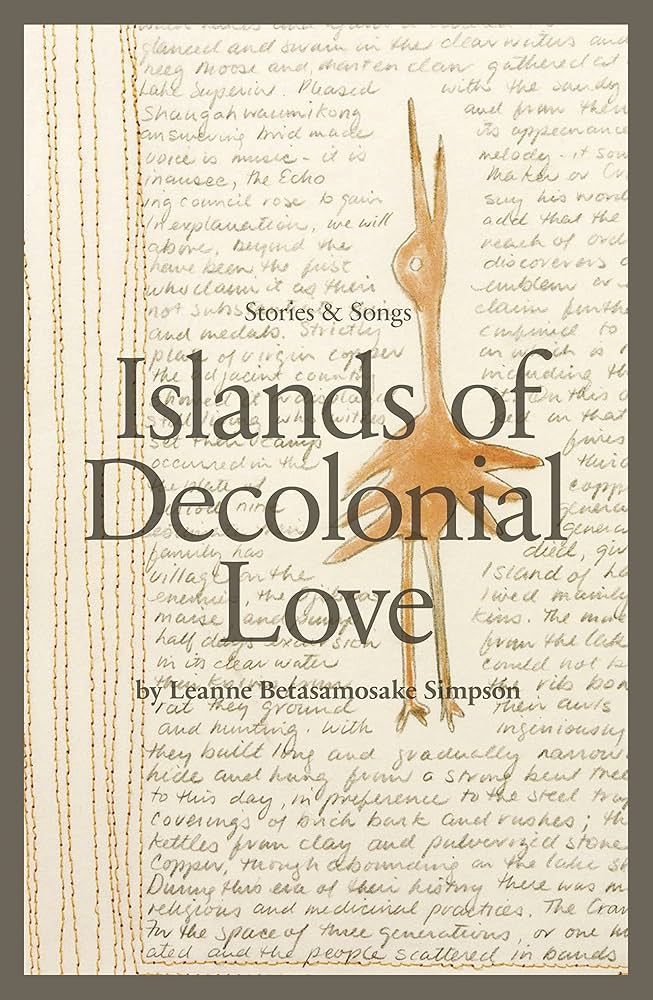
    4. Islands of Decolonial Love (2013)

    As is my habit, I went into Islands of Decolonial Love completely blind. Pressing play on the audiobook version as I started a day of garden work, I had no idea that I would be taken on a journey from the intimacies of kissing strangers and dating in small towns to the vastness of Anishnaabe cosmology and feeling the great Turtle’s gratitude for the massaging footsteps of dancers on her back.

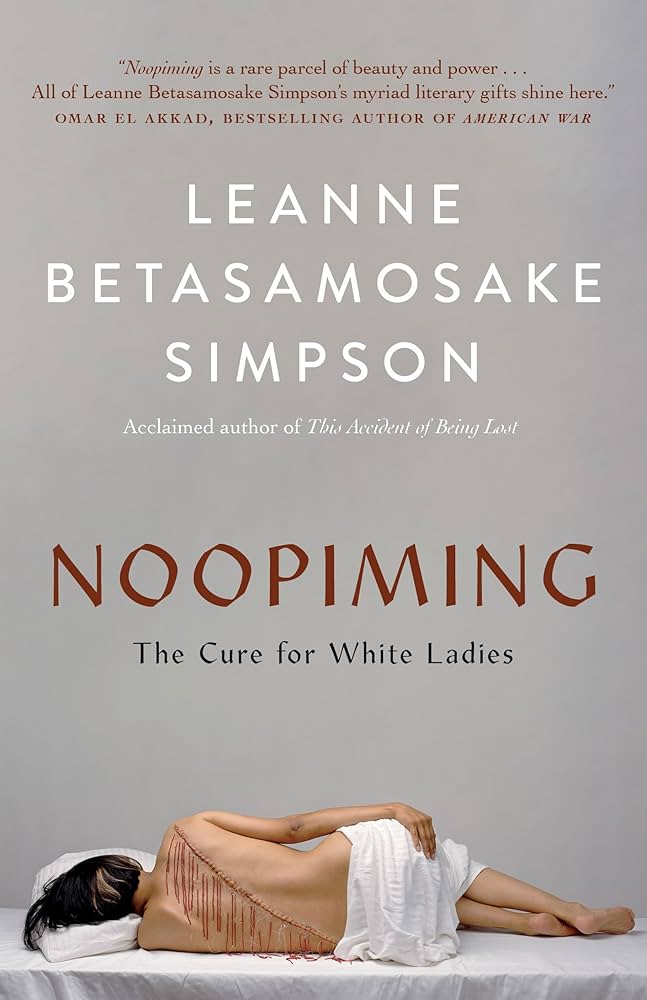
    5. Noopiming (2020)

    Noopiming is queer both in the sense of gender diversity and in the sense of strangeness.

    In an experimental style that flips between the humor of mundanity and a heightened, atmospheric mythologization of the self, Simpson lets us peek into the interrelated lives of seven allegorical characters–human, maple tree, caribou, and giant alike–who buy blue tarps on sale, make waterbottle sculptures, birdwatch in the park, and illegally carve away on a sacred rock through sleepless nights.

  • Hello, I am starting a blog!

    As social media platforms implode and news sources become increasingly unintelligible, I have been enjoying the return of blogging and email subscription newsletters. What relief I feel to read a thoughtfully written post by a friend or someone I admire amidst an otherwise mind-numbing blizzard of ads, AI nonsense, and algorithmic interference.

    Now feels like the time for me to join in this mode of sharing for a few reasons. First of all, I have been engaging with some fascinating material lately and need an outlet to articulate my feelings about it all. This may come in the form of book recommendations, short essay, and personal narrative. My network of interests include decolonization and postcolonial studies, folklore and mythology, cultural studies, stories about land, and media theory.

    Secondly, I am migrating my website here to WordPress because the three-year subscription I paid to Wix in February 2023 is finally coming to an end. Wix is an Israeli company, something I didn’t have a scooby about prior to October 2023, and which I am now boycotting in solidarity with the BDS movement.

    WordPress, being one of the old school open source blogging platforms, just kindles that special Millennial warmth that makes me want to copy-paste some CSS and send out a newsletter…

    Not least, I am keen to share some of my creative projects directly with a list of people who might care. Occasional poems, comics, announcements.

    My heart in your inbox. Would you like that?